New era for air force with modern jets
The arrival of six Gripen jet fighters today will usher in a modern era for the Royal Thai Air Force, commander Itthaporn Subhawong says.
The air force will take delivery of 12 Swedish-made Gripen fighters, worth almost 40 billion baht, after the cabinet approved the purchase of the jets in 2008 when Samak Sundaravej was the prime minister and defence minister.
The Gripen 39 C/D aircraft will replace the ageing F-5A/B jets. The F-5A/B aircraft will be completely phased out by the end of this year.
The first batch of the Gripen fighters is due to arrive at Don Muang air force base after flying out of Sweden on Feb18 and will be stationed at the Wing 7 air force base in Surat Thani.
The second batch of six Gripen jet fighters is scheduled to arrive next year.
ACM Itthaporn said yesterday he was convinced the jet fighters would bring modern and significant changes to the air force.With the fighters, the air force would be transformed to a network-oriented system, he said.
'The Gripen is like a new type of computer with all the modern stuff. Most importantly, the supplier has agreed to transfer all the technology to us,'' ACM Itthaporn said, adding that software for the fighters could be constantly updated.
He said the capabilities of fighter pilots would have to change completely as the new system on the jets would provide them with flight information linked to the other fighters on a screen before them.
ACM Itthaporn said the US had allowed the Secos-link system on the Gripen fighters to link with the system of the US-made F16 fighters.
An air force source said permission was obtained after Prime Minister Abhisit Vejjajiva raised the matter with US President Barack Obama during his visit to the US last month.
ACM Itthaporn said the air force was working closely with the navy to develop a data link system because the two forces would soon hold a joint military exercise and information on the Gripen fighters would be hooked up with navy ships.
The frigate HTMS Naresuan would be the first to be linked with the fighters, he said.
ACM Itthaporn said a Saab 340 Erieye airborne early warning aircraft that the air force also bought from the Swedish government would be connected to all the Gripen fighters.
The Saab 340 aircraft is now stationed at Wing 7 air force base.
He said the air force had also spent about 1.1 billion baht on building a hangar for the Gripen jets and the Saab 340 aircraft as well as ground stations and ground logistics support systems.
ACM Itthaporn said he would conduct test flights of the six Gripen jet fighters that would be delivered today.
The air force chief conducted test flights of Gripen fighters in Sweden in 2004 when he was chief of the directorate of RTAF operations.
The air force later decided to purchase the 12 Gripen fighters in 2007 and submitted a request to the cabinet the following year.
He said a cabinet meeting on Feb 15 also approved a budget of about 6.9billion baht to be spent on an upgrade for the air force's six F16 jet fighters that would be stationed at Wing 4, Takhli air force base in Nakhon Sawan province.
He thanked Prime Minister Abhisit for throwing his support behind the project and said the premier had a good understanding of the air force's needs.
''We are not getting any commission from the purchase of the air force jet fighters,'' ACM Itthaporn said.

Tampilkan postingan dengan label air force. Tampilkan semua postingan
Tampilkan postingan dengan label air force. Tampilkan semua postingan
Selasa, 22 Februari 2011

Jumat, 18 Februari 2011
F-35 for RAAF Will Be Arrived On Time on 2014

Company officials said in Canberra yesterday the RAAF should have a squadron of 14 of the fighter bombers by 2018, as planned.
The government says it wants to buy up to 100 multi-role JSFs to replace the retired F-111 bombers and the RAAF's F/A-18 Hornet fighter-bombers.
The first two JSFs, now designated the F-35 Lightning ll, will be used to train Australian pilots and ground crew in the US.
The Lockheed Martin officials said yesterday they had won the $3.5 billion contract to supply the navy's new helicopter that will replace its ageing Seahawks.
The company has teamed up with US helicopter firm Sikorsky to offer the new MH-60R Seahawk, or Romeo, and is competing with Eurocopter's NH90 NFH, or NATO Frigate Helicopter.
The officials said they could offer the Australian government a deal whereby the American companies would take back the older helicopters to be refurbished and sold to customers who needed helicopters for less demanding roles.
Lockheed Martin also announced yesterday it has appointed retired naval officer Raydon Gates as chief executive for Lockheed Martin Australia.
Sources : theaustralia
Kamis, 17 Februari 2011
Gates: China stealth fighter trails U.S. planes
WASHINGTON — The United States will retain a far bigger fleet of top-end fighter planes than China for years to come despite Beijing’s early test of a stealth-style jet that has stoked concern over its military buildup, the U.S. defense chief said Thursday
Defense Secretary Robert Gates told lawmakers that China faces a “long road” before deploying its J-20 stealth fighter in any numbers, and predicted a continuing “huge disparity” compared with America’s fleet of low-observable aircraft.
The chief of the Pacific Command, Adm. Robert Willard, acknowledged that China also has a “formidable” ballistic missile capability that has grown for two decades.
Willard said the United States was watching “very carefully,” and it was important for China to be open and hold a dialogue with the U.S. and other countries in the region about its intentions.
“If the two militaries are coming into contact with each other at the rate they are, then it’s important that my commanders on the high seas or my mission commanders in the air have enough familiarity with that counterpart military not to misjudge, miscommunicate or misunderstand,” he told journalists, alluding to concerns that a chance confrontation could spark conflict.
China’s military buildup has caused unease among its neighbors in the Asia-Pacific, with whom it has territorial disputes. China’s buildup also has raised questions about how long the United States can retain its military predominance in the region, which Washington views as vital for stability and policing sea lanes that keep for international trade moving.
China’s arsenal of ballistic and cruise missiles, including one designed to target an aircraft carrier, and its growing surface and submarine fleet, could potentially constrain U.S. operations in waters of the western Pacific, although Willard maintained that China’s capabilities had not necessitated a rethinking of America’s military strategy for the region.
The U.S. Pacific Fleet alone includes five aircraft carrier strike groups, approximately 180 ships, 1,500 aircraft and 100,000 personnel.
China maintains that it has no offensive intentions, and sees its military capabilities as in keeping with its rising economic and diplomatic influence.
In a move seen by some as flagging the communist nation’s clout, however, China staged a test flight of its stealth jet during a visit by Gates to Beijing in January aimed at rekindling military ties.
Beijing had severed contacts earlier in response to the latest U.S. announcement of arms sales to Taiwan.
Gates told the Senate Armed Services Committee that the test flight was between half and one year earlier than U.S. intelligence estimates. He played down its significance, saying the United States would retain far more “fifth generation” fighter jets than China for years.
“There’s still a huge disparity in terms of these aircraft,” Gates said. “This is their first low-observable aircraft and given the challenges we have had, and we have been at this for more than 20 years, they have a long road in front of them before this becomes a serious operational aircraft in any numbers.”
He said China may have 50 of the aircraft deployed by 2020, and a couple of hundred by 2025.
Despite rolling back acquisition of top-end F-35 jets for five years as part of budget cuts, Gates said the United States still will have 325 F-35 jets by the end of 2016, and in addition to its F-22 jets, would have in all about 850 fifth-generation aircraft by 2020.
He predicted the number would rise to 1,500 by 2025.
Sources : airforcetimes
Defense Secretary Robert Gates told lawmakers that China faces a “long road” before deploying its J-20 stealth fighter in any numbers, and predicted a continuing “huge disparity” compared with America’s fleet of low-observable aircraft.
The chief of the Pacific Command, Adm. Robert Willard, acknowledged that China also has a “formidable” ballistic missile capability that has grown for two decades.
Willard said the United States was watching “very carefully,” and it was important for China to be open and hold a dialogue with the U.S. and other countries in the region about its intentions.
“If the two militaries are coming into contact with each other at the rate they are, then it’s important that my commanders on the high seas or my mission commanders in the air have enough familiarity with that counterpart military not to misjudge, miscommunicate or misunderstand,” he told journalists, alluding to concerns that a chance confrontation could spark conflict.
China’s military buildup has caused unease among its neighbors in the Asia-Pacific, with whom it has territorial disputes. China’s buildup also has raised questions about how long the United States can retain its military predominance in the region, which Washington views as vital for stability and policing sea lanes that keep for international trade moving.
China’s arsenal of ballistic and cruise missiles, including one designed to target an aircraft carrier, and its growing surface and submarine fleet, could potentially constrain U.S. operations in waters of the western Pacific, although Willard maintained that China’s capabilities had not necessitated a rethinking of America’s military strategy for the region.
The U.S. Pacific Fleet alone includes five aircraft carrier strike groups, approximately 180 ships, 1,500 aircraft and 100,000 personnel.
China maintains that it has no offensive intentions, and sees its military capabilities as in keeping with its rising economic and diplomatic influence.
In a move seen by some as flagging the communist nation’s clout, however, China staged a test flight of its stealth jet during a visit by Gates to Beijing in January aimed at rekindling military ties.
Beijing had severed contacts earlier in response to the latest U.S. announcement of arms sales to Taiwan.
Gates told the Senate Armed Services Committee that the test flight was between half and one year earlier than U.S. intelligence estimates. He played down its significance, saying the United States would retain far more “fifth generation” fighter jets than China for years.
“There’s still a huge disparity in terms of these aircraft,” Gates said. “This is their first low-observable aircraft and given the challenges we have had, and we have been at this for more than 20 years, they have a long road in front of them before this becomes a serious operational aircraft in any numbers.”
He said China may have 50 of the aircraft deployed by 2020, and a couple of hundred by 2025.
Despite rolling back acquisition of top-end F-35 jets for five years as part of budget cuts, Gates said the United States still will have 325 F-35 jets by the end of 2016, and in addition to its F-22 jets, would have in all about 850 fifth-generation aircraft by 2020.
He predicted the number would rise to 1,500 by 2025.
Sources : airforcetimes
Selasa, 15 Februari 2011
B-17 vet back in air aboard a WWII-era bomber
CLEARWATER, Fla. — A day before his final mission aboard a B-17 bomber in World War II, Norbert Swierz sat down on his bunk and jotted down a poem for his mother back in Michigan.
“I go so gladly to my fate, whatever it may be. That I would have you shed no tears for me,” wrote the 23-year-old gunner, who had already survived the ditching of his first B-17 in the North Sea that summer of 1943. “Some men must die, that others must be free. And only God can say whom these shall be.”
The next day, Sept. 6, 1943, “Skeets” Swierz and the rest of the crew of the B-17 nicknamed “Bomb Boogie” took off from their base in England, but didn’t make it back. Shot down and taken prisoner, Swierz would spend the rest of his war days in a POW camp and not fly in another B-17 for close to 70 years.
The opportunity came again last Friday, and Swierz didn’t hesitate. He strapped himself into a restored Flying Fortress and held on as the four droning engines lifted the vintage bomber off a central Florida airstrip into heavy cloud cover.
“Wonderful,” the grinning 90-year-old man kept saying during the 45-minute flight. “Wonderful.”
Strapped into the radio operator’s chair halfway back, Swierz looked around and reeled off the name of the man on his crew who occupied the same seat on his old plane, and the name of the gunner who had squeezed into the ball turret underneath. That’s what he was thinking about most, the other guys.
“They’re all gone now, but I still have the memories,” he said. “They were all kids then, just like myself.”
Swierz’s flight came courtesy of the Collings Foundation, which tours the country with several planes restored to their World War II condition. More than 12,000 B-17s were manufactured for the war effort, and the Massachusetts-based charity owns one of a handful around the world that can still get off the ground. Foundation spokesman Hunter Chaney said it’s important to put the old veterans together with the vintage aircraft while that’s still possible.
“We’re in the last throes of this generation,” he said from Stow, Mass. “It’s an increasing rarity that we’re able to share this with our World War II veterans. It adds a sense of urgency to living history programs like this.”
A top-turret gunner in those days — which means he poked his head up into a plastic bubble above the cockpit and blazed away on twin .50-caliber machine guns — Swierz was one of the lucky ones.
Participation in those daylight, precision bombing raids on industrial targets in Germany and occupied France was dangerous and terrifying duty, dramatically recounted in movies such as “Twelve O’Clock High” and “Memphis Belle.” Two out of three young men — their average age was 20 — who flew on those missions did not survive the war. Swierz recalls returning from one especially bad mission and going to bed in an empty barracks.
“Let me tell you, that was a spooky night,” he said.
Swierz grew up in Chicago and Michigan — his mother lived in Dowagiac — and was 21 when he went to Canada to join the British Civilian Technical Corps, a mercenary outfit for those who wanted to help out the British before the United States was pulled into World War II. After Pearl Harbor, he enlisted in the U.S. Army Air Corps and volunteered for B-17 duty.
He flew his first mission on March 18, 1943. His luck held out until June 22 when his plane — nicknamed “Old Ironsides” — was shot up so badly it had to be ditched in the North Sea after a bombing run on a German factory. He was plucked from the sea by a British rescue boat and spent weeks in the hospital recovering from a shrapnel wound to his leg.
His 14th mission — the bombing of a ball-bearing factory in Stuttgart, Germany — would be his last. B-17 crews needed 25 successful missions to rotate home, and most didn’t make it. The crew of the famous “Memphis Belle” — they shared a central England base with Swierz and his mates — was the first to do it in May 1943.
“Somehow or another, the Germans always knew we were coming and where we were going to bomb,” Swierz said. “The German fighters were something else. They were fearless. They would come right down through the middle of our formations, scattering B-17s all over hell.”
The attack on Stuttgart was a fiasco. German fighters and flak batteries battered the planes as they flew around looking for a break in the clouds so they could drop their bombs. Of the 338 B-17s on the mission, 45 were lost. Many ran out of gas.
“Bomb Boogie” was pounded by flak and enemy fighters soon after releasing its bombs, and the 10 young men bailed out over Stuttgart, their parachutes blooming in the gray sky. Swierz was captured immediately and spent the rest of the war in a prison camp in Austria.
Swierz and his fellow prisoners were liberated by Gen. George Patton’s Third Army in May 1945. He made it home and has done a lot of living since then. Wife, kids, grandkids, great-grandkids, a long military career, a long retirement. But his recollections of wartime duty in the B-17 have survived in fairly sharp focus.
Swierz’s oldest son, Greg, said his father didn’t start talking about those war experiences in depth until about 10 years ago. His family finally persuaded him to write down the memories.
“I think it was a pretty horrific adventure, and it was just a part of their lives that they just got through,” said Greg Swierz, a retired commercial pilot. “I think they realize now that they are living history, and we’ve got to get it out of them. They are real heroes.”
Sources : airforcetimes
“I go so gladly to my fate, whatever it may be. That I would have you shed no tears for me,” wrote the 23-year-old gunner, who had already survived the ditching of his first B-17 in the North Sea that summer of 1943. “Some men must die, that others must be free. And only God can say whom these shall be.”
The next day, Sept. 6, 1943, “Skeets” Swierz and the rest of the crew of the B-17 nicknamed “Bomb Boogie” took off from their base in England, but didn’t make it back. Shot down and taken prisoner, Swierz would spend the rest of his war days in a POW camp and not fly in another B-17 for close to 70 years.
The opportunity came again last Friday, and Swierz didn’t hesitate. He strapped himself into a restored Flying Fortress and held on as the four droning engines lifted the vintage bomber off a central Florida airstrip into heavy cloud cover.
“Wonderful,” the grinning 90-year-old man kept saying during the 45-minute flight. “Wonderful.”
Strapped into the radio operator’s chair halfway back, Swierz looked around and reeled off the name of the man on his crew who occupied the same seat on his old plane, and the name of the gunner who had squeezed into the ball turret underneath. That’s what he was thinking about most, the other guys.
“They’re all gone now, but I still have the memories,” he said. “They were all kids then, just like myself.”
Swierz’s flight came courtesy of the Collings Foundation, which tours the country with several planes restored to their World War II condition. More than 12,000 B-17s were manufactured for the war effort, and the Massachusetts-based charity owns one of a handful around the world that can still get off the ground. Foundation spokesman Hunter Chaney said it’s important to put the old veterans together with the vintage aircraft while that’s still possible.
“We’re in the last throes of this generation,” he said from Stow, Mass. “It’s an increasing rarity that we’re able to share this with our World War II veterans. It adds a sense of urgency to living history programs like this.”
A top-turret gunner in those days — which means he poked his head up into a plastic bubble above the cockpit and blazed away on twin .50-caliber machine guns — Swierz was one of the lucky ones.
Participation in those daylight, precision bombing raids on industrial targets in Germany and occupied France was dangerous and terrifying duty, dramatically recounted in movies such as “Twelve O’Clock High” and “Memphis Belle.” Two out of three young men — their average age was 20 — who flew on those missions did not survive the war. Swierz recalls returning from one especially bad mission and going to bed in an empty barracks.
“Let me tell you, that was a spooky night,” he said.
Swierz grew up in Chicago and Michigan — his mother lived in Dowagiac — and was 21 when he went to Canada to join the British Civilian Technical Corps, a mercenary outfit for those who wanted to help out the British before the United States was pulled into World War II. After Pearl Harbor, he enlisted in the U.S. Army Air Corps and volunteered for B-17 duty.
He flew his first mission on March 18, 1943. His luck held out until June 22 when his plane — nicknamed “Old Ironsides” — was shot up so badly it had to be ditched in the North Sea after a bombing run on a German factory. He was plucked from the sea by a British rescue boat and spent weeks in the hospital recovering from a shrapnel wound to his leg.
His 14th mission — the bombing of a ball-bearing factory in Stuttgart, Germany — would be his last. B-17 crews needed 25 successful missions to rotate home, and most didn’t make it. The crew of the famous “Memphis Belle” — they shared a central England base with Swierz and his mates — was the first to do it in May 1943.
“Somehow or another, the Germans always knew we were coming and where we were going to bomb,” Swierz said. “The German fighters were something else. They were fearless. They would come right down through the middle of our formations, scattering B-17s all over hell.”
The attack on Stuttgart was a fiasco. German fighters and flak batteries battered the planes as they flew around looking for a break in the clouds so they could drop their bombs. Of the 338 B-17s on the mission, 45 were lost. Many ran out of gas.
“Bomb Boogie” was pounded by flak and enemy fighters soon after releasing its bombs, and the 10 young men bailed out over Stuttgart, their parachutes blooming in the gray sky. Swierz was captured immediately and spent the rest of the war in a prison camp in Austria.
Swierz and his fellow prisoners were liberated by Gen. George Patton’s Third Army in May 1945. He made it home and has done a lot of living since then. Wife, kids, grandkids, great-grandkids, a long military career, a long retirement. But his recollections of wartime duty in the B-17 have survived in fairly sharp focus.
Swierz’s oldest son, Greg, said his father didn’t start talking about those war experiences in depth until about 10 years ago. His family finally persuaded him to write down the memories.
“I think it was a pretty horrific adventure, and it was just a part of their lives that they just got through,” said Greg Swierz, a retired commercial pilot. “I think they realize now that they are living history, and we’ve got to get it out of them. They are real heroes.”
Sources : airforcetimes
Selasa, 08 Februari 2011
Marshall Aerospace Pitches C-130 Upgrade to Malaysia

Marshall says it hosted Royal Malaysian Air Force chief of staff Gen Tan Sri Dato' Sri Rodzali bin Daud in a visit to its Cambridge airport facilities on 10 January.
The company has identified a Malaysian requirement "for an upgrade of their C-130H avionics to provide a capability to fly in CNS/ATM [communications, navigation and surveillance/air traffic management] airspace", says head of business development Peter Taylor.
Marshall has recently conducted an extensive avionics and cockpit upgrade on two refurbished C-130Hs for the Royal Netherlands Air Force and will perform the same work on two more Dutch aircraft. Last year it identified a possible market to offer a similar service to Hercules operators in Asia, Europe and North Africa.
The Royal Malaysian Air Force has an active fleet of 12 C-130H/H-30s and two C-130T tankers, as listed in Flightglobal's MiliCAS database. The five oldest of these entered service in 1976, it says.
As well as operating its Hercules fleet, Malaysia is the lone export buyer for Airbus Military's larger A400M. Kuala Lumpur has ordered four of the European type.
Sources : flightglobal
Soviet Military Power 1985 - Strategic Defense and Space Programs
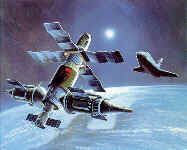
Soviet Military Power 1983 and 1984 outlined the continuing expansion into space of the Soviet drive for military superiority. In the past year, some 80 percent of Soviet space launches have been purely military in nature, with much of the remainder serving both military and civil functions. This is an increase from 70 percent in previous years. The Soviet military space program dominates the USSR's overall space effort. Soviet military doctrine establishes requirements for the military space program.
Laser/Energy Weapons Systems
Soviet directed-energy development programs involve future Ballistic Missile Defense(BMD) as well as antisatellite and air-defense weapons concepts.
By the late 1980s, the Soviets could have prototypes for ground-based lasers for ballistic missile defense. Testing of the components for a large-scale deployment system could begin in the early 1990s. The many difficulties in fielding an operational system will require much development time, and initial operational deployment is not likely in this century. However, with high priority and some significant risk of failure, the Soviets could skip some testing steps and be ready to deploy a ground-based laser BMD by the early-to-mid-199Os.
Ground- and space-based particle beam weapons for ballistic missile defense will be more difficult to develop than lasers. Nevertheless, the Soviets have a vigorous program underway for particle beam development and could have a prototype space-based system ready for testing in the late 1990s.
The Soviets have begun to develop at least three types of high-energy laser weapons for air defense. These include lasers intended for defense of high-value strategic targets in the USSR, for point defense of ships at sea, and for air defense of theater forces. Following past practice, they are likely to deploy air defense lasers to complement, rather than replace, interceptors and surface-to-air missiles (SAMs). The strategic defense laser is probably in at least the prototype stage of development and could be operational by the late 1980s. It most likely will be deployed in conjunction with SAMs in a point defense role. Since the SAM and laser systems would have somewhat different attributes and vulnerabilities, they would provide mutual support. The shipborne lasers probably will not be operational until after the end of the decade. The theater force lasers maybe operational sometime sooner and are likely to be capable of structurally damaging aircraft at close ranges and producing electro-optical and eye damage at greater distances.
The Soviets are also developing an airborne laser. Assuming a successful development effort, limited initial deployment could begin in the early l990s. Such a laser platform could have missions including antisatellite operations, protection of high-value airborne assets, and cruise missile defense.
The Soviets are working on technologies or have specific weapons-related programs underway for more advanced antisatellite systems. These include space-based kinetic energy, ground- and space-based laser, particle beam, and radio frequency weapons. The Soviets apparently believe that these techniques offer greater promise for future antisatellite application than continued development of ground-based orbital interceptors equipped with conventional warheads. The Soviets also believe that military applications of directed energy technologies hold promise of overcoming weaknesses in their conventional air and missile defenses.
The USSR's high-energy laser program, which dates from the mid-1960s, is much larger than the US effort. They have built over a half dozen major R&D facilities and test ranges, and they have over 10,000 scientists and engineers associated with laser development. They are developing chemical lasers and have continued to work on other high-energy lasers having potential weapons applications - the gas dynamic laser and the electric discharge laser. They are also pursuing related laser weapon technologies, such as efficient electrical power sources, and are pursuing capabilities to produce high-quality optical components. They have developed a rocket-driven magnetohydrodynamic (MHD) generator which produces 15 megawatts of short-term electric power - a device that has no counterpart in the West. The scope of the USSR's military capabilities would depend on its success in developing advanced weapons, including laser weapons for ballistic missile defense.
The Soviets have now progressed beyond technology research, in some cases to the development of prototype laser weapons. They already have ground-based lasers that could be used to interfere with US satellites. In the late 1980s, they could have prototype space based laser weapons for use against satellites. In addition, ongoing Soviet programs have progressed to the point where they could include construction of ground-based laser antisatellite(ASAT) facilities at operational sites. These could be available by the end of the 1980s and would greatly increase the Soviets' laser ASAT capability beyond that currently at their test site at Sary Shagan. They may deploy operational systems of space-based lasers for antisatellite purposes in the l990s, if their technology developments prove successful, and they can be expected to pursue development of space-based laser systems for ballistic missile defense for possible deployment after the year 2000.
Since the early 1970s, the Soviets have had a research program to explore the technical feasibility of a particle beam weapon in space. A prototype space-based particle beam weapon intended only to disrupt satellite electronic equipment could be tested in the early 1990s. One designed to destroy satellites could be tested in space in the mid-199Os.
The Soviets have conducted research in the use of strong radio frequency (RF) signals that have the potential to interfere with or destroy components of missiles, satellites, and reentry vehicles. In the 1990s, the Soviets could test a ground-based RF weapon capable of damaging satellites.
Soviet programs for the development and application of directed-energy technologies to strategic defense have been very vigorous in the past and will continue to be so in the future, irrespective of what the US does about new strategic defense initiatives.
In the area of kinetic energy weapons, using the high-speed collision of a small mass with the target as the kill mechanism, the Soviets have a variety of research programs underway. These programs could result in a near-term, short-range, space-based system useful for satellite or space station defense or for close-in attack by a maneuvering satellite. Longer range, space-based systems probably could not be developed until the mid-199Os or even later.
Early Warning
The Soviets maintain the world's most extensive early warning system for both ballistic missile and air defense. Their operational ballistic missile early warning system includes a launch-detection satellite network, over-the horizon radar, and a series of large phased array radars located primarily on the periphery of the USSR. Their early warning air surveillance system is composed of an extensive network of ground-based radars linked operationally with those of their Warsaw Pact allies.
The current Soviet launch-detection satellite network is capable of providing about 30 minutes warning of any US ICBM launch and of determining the general area from which it originated. The two over-the-horizon radars the Soviets have directed at the US ICBM fields also could provide them with 30 minutes warning of an ICBM strike launched from the United States, but with somewhat less precision than the satellite network. Working together, these two early warning systems can provide more reliable warning than either working alone.
The next layer of operational ballistic missile early warning consists of 11 large HENHOUSE detection and tracking radars at six locations on the periphery of the USSR. These radars can distinguish the size of an attack, confirm the warning from the satellite and over-the-horizon radar systems, and provide target-tracking data in support of antiballistic missile (ABM) deployments.
Current Soviet air surveillance radar deployments include more than 7,000 radars of various types located at about 1,200 sites. These deployments provide virtually complete coverage at medium-to-high altitudes over the USSR and in some areas extend hundreds of kilometers beyond the borders. Moreover, the over the-horizon radars provide additional warning of the approach of high-flying aircraft. Limited coverage against low-altitude targets is concentrated in the western USSR and in high priority areas elsewhere. Since 1983, the Soviets have begun to deploy two new types of air surveillance radars. These radars assist in the early warning of cruise missile and bomber attacks and enhance air defense electronic warfare capabilities.
The new large phased-array radar for ballistic missile early warning and target-tracking discovered in 1983 in Siberia is still under construction. This new radar closes the final gap in the combined HEN HOUSE and new large phased-array radar early warning and tracking network. Together, this radar and the five others like it form an arc of coverage from the Kola Peninsula in the northwest, around Siberia, to the Caucasus in the southwest. The new radar violates the 1972 ABM Treaty in that it is not located on the periphery of the Soviet Union, nor is it pointed outward as required by the Treaty. Its orientation and function indicate it is for ballistic missile detection and tracking - not space object tracking as claimed by the Soviets. The complete network of these radars, which could provide target-tracking data for ABM deployments beyond Moscow, probably will be operational by the late 1980s.
The Soviets may establish a network of satellites in geostationary orbit designed to provide timely indications of ballistic missiles, including submarine-launched ballistic missile(SLBM) launches. Such a network could be operational by the end of the decade.
The USSR has a strong research and development program to produce new early warning and other air surveillance radars as well as to improve existing systems. More than 15 types of these radars are currently in development. In addition, the Soviets are continuing to deploy improved air surveillance data systems that can rapidly pass data from outlying radars through the air surveillance network to ground-controlled intercept sites and SAM command posts. These systems will continue to be deployed until all areas are equipped with them.
Ballistic Missile Defense
The Soviets are continuing a major upgrading of their ballistic missile defense capabilities. The Moscow missile defenses are being enlarged and equipped with a new generation of radars and interceptor missiles. Developments aimed at providing the foundation for widespread ABM deployments beyond Moscow are underway.
The new SA-X-12 surface-to-air missile, which incorporates ballistic missile defense capabilities, is nearing operational status, while research on directed-energy BMD technology continues apace.
The Soviets maintain around Moscow the world's only operational ABM system. This system is intended to afford a layer of defense for Soviet civil and military command authorities in the Moscow area during a nuclear war rather than blanket protection for the city itself. Since 1980, the Soviets have been upgrading and expanding this system around Moscow within the limits of the 1972 ABM Treaty.
The original single-layer Moscow ABM system included 64 reloadable above-ground launchers at four complexes for the GALOSH ABM-1B, six TRY ADD guidance and engagement radars at each complex, and the DOG HOUSE and CAT HOUSE target-tracking radars south of Moscow. The Soviets are upgrading this system to the 100 accountable launchers permitted under the ABM Treaty. When completed, the new system will be a two-layer defense composed of silo-based, long range, modified GALOSH interceptors designed to engage targets outside the atmosphere; silo-based high-acceleration interceptors designed to engage targets within the atmosphere; associated engagement and guidance radars; and a new large radar at Pushkino designed to control ABM engagements. The silo-based launchers may be reloadable. The first new launchers are likely to be operational this year, and the new defenses could be fully operational by 1987.
The Soviets are developing a rapidly deployable ABM system to protect important target areas in the USSR. They have been testing all the types of ABM missiles and radars needed for widespread ABM defenses beyond the 100 launcher limit of the 1972 ABM Treaty. Within the next 10 years, the Soviets could deploy such a system at sites that could be built in months instead of years. A typical site would consist of engagement radars, guidance radars, above-ground launchers, and the high-acceleration interceptor. The new, large phased-array radars under construction in the USSR, along with the HEN HOUSE, DOG HOUSE, CAT HOUSE, and possibly the Pushkino radar, appear to be designed to provide support for such a widespread ABM defense system. The aggregate of the USSR's ABM and ABM-related activities suggests that the USSR may be preparing an ABM defense of its national territory.
In addition, the Soviets are deploying one surface-to-air missile system, the SA-10, and are flight testing another, the mobile SA-X-12. The SA-X-12 is both a tactical SAM and antitactical ballistic missile. It may have the capability to engage the LANCE and both the PERSHING I and PERSHING II ballistic missiles. The SA-10 and SA-X-12 may have the potential to intercept some types of US strategic ballistic missiles as well. These systems could, if properly supported, add significant point-target coverage to a widespread ABM deployment.
Air Defense
undefinedThe Soviets have deployed numerous strategic and tactical air defense assets that have excellent capabilities against aircraft flying at medium and high altitudes. Although their capability to intercept low-flying penetrators is marginal, they are in the midst of a major overhaul geared toward fielding an integrated air defense system much more capable of low-altitude operations. This overhaul includes partial integration of strategic and tactical air defenses; the upgrading of early warning and surveillance capabilities; the deployment of more efficient data transmission systems; and the development and initial deployment of new aircraft, associated air-to-air missiles, surface-to-air missiles, and airborne warning and control system (AWACS) aircraft.
Over the years, the Soviets have invested enormous resources in their air defense systems. This sustained effort has produced an array of weapons systems designed for a variety of air defense applications. For example, they have fielded 13 different surface-to-air missile systems, each designed to cover a specific threat regime.
The Soviets have made significant shifts in the subordination of their air and air defense assets. The reorganization has resulted in a streamlined organization that merged strategic and tactical air and air defense assets inmost land border areas of the USSR. The air defense (APVO) interceptors became part of a new structure, the Air Forces of the Military District (MD), which also includes most of the assets of the former tactical air armies. The Air Forces of an MD include all air assets in their geographic area (excluding Strategic Aviation and transport assets). These assets can be used either offensively or defensively as the situation requires. The new structure improves defensive capabilities, but its most significant impact is on the capability to conduct massed offensive air operations. Technological advances in weapons systems and in command, control, and communications have made its implementation possible.
In terms of numbers alone, Soviet strategic and tactical air defense forces are impressive. Moreover, with the continuing deployment of new systems like the SA-10 SAM and impending deployment of the SA-X-12, these numbers are increasing along with capability. Currently, the Soviets have nearly 10,000 SAM launchers at over 1,200 sites for strategic defense, along with more than 4,000 launch vehicles for tactical SAMs, subordinated to nearly 445 launch units. More than 1,200 interceptors are dedicated to strategic defense while an additional 2,800 Soviet Air Forces(SAF) interceptors could also be used. Further, the Soviets are continuing the MAINSTAY AWACS aircraft program and test and evaluation is underway. The MAINSTAY will substantially improve Soviet capabilities for early warning and air combat command and control, especially against low-flying aircraft. The MAINSTAY will also provide Soviet air defenses with overland and overwater capabilities to detect aircraft and cruise missile targets flying at low altitudes. Additionally, the MAINSTAY could be used to help direct fighter operations over European and Asian battlefields and to enhance air surveillance and defense of the USSR. MAINSTAY production could be about five aircraft per year.
The 1,200 all-weather interceptors assigned to strategic defense are primarily based in central air defense regions of the Soviet Union, in addition to fighter/interceptors subordinate to the military districts that are generally located on the periphery of the Soviet Union. The interceptor force is composed of a wide variety of aircraft with varying capabilities.
The deployment of the supersonic MiG-31/FOXHOUND interceptor, the first Soviet aircraft with a true look-down/shoot-down and multiple-target engagement capability, continued during 1984. The FOXHOUND, comparable in size to the US F-14 TOMCAT, is deployed at several locations from the Arkhangelsk area to the Far East Military District. More than 70 of these aircraft are operational.
The MiG-25/FOXBAT A/E is a high-altitude, high-speed interceptor that comprises approximately one-quarter of the strategic interceptor force. The upgrade program of the FOXBAT A to the newer FOXBAT E configuration provides a limited look-down radar capability. The remaining FOXBAT A aircraft are expected to be modified to the FOXBAT E configuration during 1985.
The MiG-23/FLOGGER B/G fighter comprises approximately one-third of the total strategic interceptor forces. This variable geometry-wing fighter is equipped with a limited look-down radar. The remaining aircraft employed as interceptors (the older FLAGON, FIDDLER, and FIREBAR) comprise less than one-third of the force.
Two new fighter-interceptors, the Su-27/FLANKER and the MiG-29/FULCRUM, have true look-down/shoot-down capabilities. The FULCRUM is a single-seat, twin-engine fighter similar in size to the US F-16. First deployments of the FULCRUM to the Soviet Air Force military districts have begun, and more than 30 are now operational. The FLANKER is a larger, single-seat, twin-engine fighter similar in size to the US F-15. Both aircraft have been designed to be highly maneuverable in air-to-air combat.
The three latest Soviet fighter-interceptor aircraft are equipped with two new air-to-air missiles, the AA-9 designed for the FOXHOUND and the AA-10 designed for the FULCRUM and the FLANKER. The AA-9 is a long-range missile that can be used against low-flying targets; the AA-10 is a medium-range missile with similar capabilities.
The FLANKER and the FULCRUM, as well as the FOXHOUND, are likely to operate under certain circumstances with the new MAINSTAY AWACS aircraft.
Soviet strategic SAMs form barrier, area,and terminal defenses. They afford broad coverage for medium- and high-altitude defenses under all weather conditions. Five systems are operational - the SA-1, SA-2, SA-3, SA-5, and SA-10. Of these, only the SA-10 is capable of defending against targets with a small radar cross-section such as cruise missiles.
The first SA-10 site reached operational status in 1980. Nearly 60 sites are now operational and work is underway on at least another 30. More than half of these sites are located near Moscow. This emphasis on Moscow and the patterns noted for the other SA-10 sites suggest a first priority on terminal defense of wartime command and control, military, and key industrial complexes. Over the years, the Soviets have continued to deploy the long-range SA-5 and have modified the system repeatedly. Further deployment and upgrading of the SA-5 to enhance its capability to work in conjunction with low-altitude systems like the SA-10 are likely in the future.
In keeping with their drive toward mobility as a means of weapons survival, the Soviets are developing a mobile version of the SA-10 SAM. This mobile version could be used to support Soviet theater forces but, perhaps more importantly, if deployed with the territorial defense forces, it would allow the Soviets to change the location of SA-10 sites in the USSR. The mobile SA-10 could be operational sometime this year.
The 1980 air defense reorganization permits efficient integration of strategic and tactical SAM systems. Most tactical SAMs are not as range-capable as strategic SAMs, but many have better low-altitude capabilities.
A mixed and integrated system of aircraft, SAMs, and antiaircraft artillery (AAA) provides the Soviet Union with the most comprehensive air defense system in the world. Over 4,600 SAM launcher vehicles and 11,500 AAA pieces are deployed at regimental through front level. In addition, as many as 25,000 shoulder fired SAM launchers are found at battalion and company level and with non-divisional units. The standard air defense for a tank or motorized rifle regiment is a battery of SA-9/13 SAMs and ZSU-23/4 self-propelled AAA pieces. The SA-9 system, mounted on a wheeled transporter erector-launcher (TEL), is being replaced by the SA-13 on a tracked TEL. A follow-on to the ZSU-23/4 is expected shortly. The standard SAM at division level is the SA-6 or SA-8, although some divisions still have an AAA equipped air defense regiment. A new division level SAM, the SA-ll, is beginning to enter the inventory. It features an onboard radar that increases mobility and target-handling capability. The standard weapon at army and front levels is the SA-4, soon to be replaced by the SA-X-12. The SA-X-12 has good low-altitude air defense capabilities as well as the ballistic missile defense capabilities noted above. Soviet tactical SAM development is both broad based and active. New tactical SAMs and improvements to older ones are now under development.
The largest concentration of SAM launchers and AAA pieces - over 8,100 - is found opposite European NATO; over 4,200 are opposite the Sino-Soviet border and in the Far East; there are nearly 700 opposite southwest Asia and eastern Turkey; over 1,300 are in the Strategic military districts.
Soviet passive defense preparations have been underway in earnest for some 30 years and have, over time, expanded from the protection of such vital entities as the national Party and government leadership and Armed Forces to embrace the territorial leadership, national economy, and general population. The Soviets regard passive defense as an essential ingredient of their overall military posture and war planning. In conjunction with active forces, the Soviets plan for a passive defense program to ensure the survival and wartime continuity of:
- Soviet leadership;
- military command and control entities;
- war-supporting industrial production and services;
- the essential workforce; and
- as much of the general population as possible.
As this program has expanded, elements of it have been designated by the Soviets as "civil defense." Use of this term in its normal Western context does not convey the full scope of Soviet Civil Defense.
Extensive planning for the transition of the entire State and economy to a wartime posture has been fundamental to Soviet passive defense preparations. The Soviet General Staff and Civil Defense officials have supervised the development of special organizations and procedures to implement a rapid transition to war and have emphasized the mobilization and protection of all national resources essential to the successful prosecution of war and recovery.
The senior Soviet military establishment has also supervised the 30-year program to construct hardened command posts and survivable communications for key military commanders and civilian managers at all levels of the Party and government. Likewise, protective hardening, dispersal, and wartime production plans for Soviet industry have all been coordinated with the wartime requirements of the military and supervised by Civil Defense personnel. The protection of the general population through evacuation procedures and extensive sheltering in or near urban areas is the most visible aspect of the passive defense program.
The passive defense program reflects the Soviets' belief of their wartime need. The wartime management system would be the militarized system of national administration in which peacetime government bodies become Civil Defense components under direct military subordination. This would extend to Soviet territorial administration at all levels and to specialized functional components such as industrial, transport, power, and communications ministries. Soviet authorities at all levels would serve as uniformed chiefs of Civil Defense and command their respective organizations in a military capacity. Soviet Civil Defense thus serves both as a vehicle to administer peacetime preparations and training and as the infrastructure that would keep together civil and military bodies in the unified wartime management systems.
Soviet commanders and managers at all levels of the Party and government are provided hardened alternate command posts located well away from urban centers. This comprehensive and redundant system, composed of more than 1,500 hardened facilities with special communications, is patterned after similar capabilities afforded the Armed Forces. More than 175,000 key personnel throughout the system are believed to be equipped with such alternate facilities in addition to the many deep bunkers and blast shelters in Soviet cities.
Soviet passive defense efforts include measures to maintain essential production and services even during a nuclear war. Elaborate plans have been set for the full mobilization of the national economy in support of the war effort and the conversion to wartime production. Reserves of vital materials are maintained, many in hardened underground structures. Redundant industrial facilities have been built and are in active production. Industrial and other economic facilities have been equipped with blast shelters for the work force, and detailed procedures have been developed for the relocation of selected plants and equipment. By ensuring the survival of essential workers, the Soviets intend to reconstitute vital production programs using those industrial components that can be redirected or salvaged after an attack.
The annual military and civilian cost of four elements of the program - pay and allowances for full-time Civil Defense personnel; operation of specialized military Civil Defense units; construction and maintenance of facilities for these units; and shelter construction - is less than 1 percent of the estimated Soviet defense budget. If duplicated in the United States, these four elements would cost roughly $3 billion annually. The cost of construction and equipment for leadership relocation sites over the past 25 years is between 8 and 16 billion rubles, or $28-56 billion if acquired in the United States.
North American Defense Forces
United States and Canadian interceptor forces assigned to the North American Aerospace Defense Command (NORAD) maintain continuous ground alert at sites around the periphery of the United States and Canada. Alert aircraft intercept and identify unknown intruders. At present, there are no SAMs for US continental air defense. In a crisis, the Air Force, Navy, and Marine Corps could provide additional interceptors. Supported by AWACS aircraft, these forces could provide a limited defense against bomber attacks.
To meet the increasing Soviet bomber and air-launched cruise missile (ALCM) threats, US interceptor squadrons assigned to NORAD are being equipped with newer more advanced F-15 and F-16 aircraft. These modern fighters will provide a look-down/shoot-down capability to detect and engage enemy bombers penetrating at low altitudes. The Canadians are upgrading their air defense forces with the CF-18. Joint United States and Canadian improvements to long-range surveillance include modern microwave radars for the Distant Early Warning line and over-the-horizon back-scatter radars looking east, west, and south.
Soviet space-oriented military systems pose a threat to the land, sea, and air forces of the United States. Some Soviet satellites are designed to support targeting of Soviet antiship cruise missiles launched against US surface ships. The US ASAT program, centering on the Air-Launched Miniature Vehicle, is part of the response to this and similar threats.
Finally, the United States has called for a research program to explore the possibility of strengthening deterrence by taking advantage of recent advances in technology that could, in the long term, provide an effective defense against ballistic missiles. This Strategic Defense Initiative (SDI) is discussed in the concluding chapter.
The Soviet Space Program
The Soviets believe in the combined arms concept of warfare in which all types of forces are integrated into military operations to achieve the desired goals. Space assets play a major role in this equation in the areas of antisatellite warfare; intelligence collection; command, control, and communications; meteorological support; navigational support; and targeting. The military support systems are linked to ground, naval, and air forces through earth terminals. Thus, Soviet forces can receive orders and information via satellite from command headquarters thousands of miles away. Their reliance on these systems is growing. Space weapons also play an important role in their strategic operations.
The late Marshal V.D. Sokolovskiiy included space in a statement defining the modern concept of a theater of military operations. The Soviet drive to use space for military purposes is an integral part of Soviet military planning. The Soviet coorbital ASAT system, while launched from the ground, is a space weapon system. The Soviets also have two ground-based lasers that are capable of attacking satellites in various orbits. These systems suggest that the Soviets are willing to use space for military purposes that are more ominous than those for which it has been used thus far.
The Soviets are currently developing a version of the US space shuttle, a heavy-lift booster system, a space plane, and directed-energy weapons and have engaged in military-related experiments aboard the SALYUT-7 space station. The Soviets continue to pursue their manned space programs, maintaining in orbit the SALYUT space station, which is manned during most of the year. This gives the Soviets the capability to perform a variety of functions from space, including military R&D and using man to augment their other reconnaissance and surveillance efforts. In addition, there are other developments indicating Soviet research on space-based ballistic missile defense.
Antisatellite Systems. Since 1971, the Soviets have had the capability to attack satellites in near-earth orbit with a ground-based orbital interceptor. Using a radar sensor and a pellet-type warhead, the interceptor can attack a target in various orbits during the interceptor's first two revolutions. An intercept during the first orbit would minimize the time available for a target satellite to take evasive action. The interceptor can reach targets orbiting at more than 5,000 kilometers, but it probably is intended for high-priority satellites at lower altitudes. The antisatellite interceptor is launched from Tyuratam, where launch pads and storage space for interceptors and launch vehicles are available. Several interceptors could be launched each day. In addition to the orbital interceptor, the Soviets have two ground-based, high-energy lasers with antisatellite capabilities. The Soviets also have the technological capability to conduct electronic warfare against space systems and could use their ABM interceptors in a direct-ascent attack on low-orbiting satellites.
Space Boosters. The Soviets currently maintain eight space launch systems that are used to place objects in orbits ranging from low earth to geosynchronous and beyond. They are developing two more systems - a TITAN Class medium-lift launch vehicle and a SATURN V-Class heavy-lift vehicle. Also, they are developing their version of the US shuttle orbiter, which seems almost identical to its US counterpart, except for the absence of main engines. It is estimated that the new heavy-lift vehicle will be used to launch their orbiter as well as other large payloads. This vehicle should be able to lift as much as 150,000 kilograms to low-earth orbit, giving the USSR a tremendous capability to orbit heavy objects, such as the components for a large, manned space complex. The estimate for the medium-lift vehicle is a payload capacity of approximately 15,000 kilograms. This system may be used to launch their space plane, discussed below.
Manned Space Program. The Soviets have emphasized man in space since the beginning of their space program. In 1961 they placed the first man into orbit. Their SALYUT space stations have accommodated cosmonauts for extended periods, setting several records in the process. In 1984, three cosmonauts set a new record, spending 237 days aboard SALYUT 7. In 1982, two Soviet cosmonauts spent 211 days aboard the space station. At the end of 1984, Soviet cosmonauts had accumulated 3,691 man days in space, compared to the US astronaut total of 1,289. In the spring of 1984, Soviet cosmonauts demonstrated their capability to perform on-orbit maintenance and repair by conducting extra-vehicular activity (EVA) five times, gaining valuable experience in on-orbit repairs. During one EVA, added new solar panels to SALYUT 7. During another EVA, the Soviets accomplished another space first - a space walk by a female cosmonaut, Svetlana Savitskaya.
The Soviets have made known their plans to replace SALYUT 7 with large space complexes, supporting 20 or more cosmonauts on a permanent basis. Such a complex will enhance their space-based military support and warfighting capabilities. Missions could include military R&D, on-orbit repair of satellites, reconnaissance, imagery interpretation, ASAT support operations, and ballistic missile defense support operations. Their shuttle orbiter will likely be used to ferry cosmonauts to this station as well as to place satellites in orbit.
The Soviets apparently have already found some military utility in their manned space program. They have stated that "earth surface surveys" were conducted during past manned missions, but none of the photographs has ever been published. The continuation of photographic and other missions aboard SALYUT 7 indicates the Soviets are aware of the potential value of manned space stations in an actual wartime situation.
The Soviets have been experimenting with a test vehicle that is apparently a scale model of a larger, manned space plane. The vehicle has been orbited unmanned on four occasions, landing this plane's possible missions include reconnaissance, crew transport, satellite repair and maintenance, and ASAT operations. It could also be used as a manned space station defender. A clue to its purpose is found in a 1965 Soviet definition of antispace defense: "A component part of air defense. The main purpose of antispace defense is to destroy space systems used by the enemy for military purposes, in their orbits. The principal means of antispace defense are special spacecraft and vehicles (e.g., satellite interceptors), which may be controlled either from the ground or by special crews."
The Soviets have openly discussed their plans for ambitious planetary exploration in spite of their apparent decision not to match US lunar expeditions. In 1992, the condition for a launch to Mars will be favorable, and the Soviets are considering a manned expedition to that planet at that time. They have stated that the recent manning of the SALYUT space station for increasingly longer periods of time is to simulate the time it would take to conduct a Mars mission. This time frame also coincides with the 75th anniversary of the Bolshevik Revolution and with the 500th anniversary of Columbus' discovery of the New World. Such an expedition would add great prestige to the Soviet Union and would further demonstrate the capability of its space technology.
Military Space Systems. Soviet space systems dedicated to military missions include satellites that perform reconnaissance, missile-launch detection and attack warning, command and control, and ASAT operations. Dual-purpose satellites that perform some civilian functions are used for communications, navigational support, and weather prediction and monitoring. The US has no counterpart to Soviet ocean reconnaissance satellites, the Electronic Intelligence Ocean Reconnaissance Satellite (EORSAT), or the nuclear-powered Radar Ocean Reconnaissance Satellite (RORSAT). Their mission is to detect, locate, and target US and Allied naval forces for destruction by antiship weapons launched from Soviet platforms. These systems track naval and merchant shipping. Four such satellites were launched in 1984, two of which were of the same type (RORSAT) that crashed in 1978, one spreading radioactive debris across northern Canada.
The Soviets have recently employed a new radar-carrying satellite system. Designed for mapping ice formations in polar regions, these satellites will greatly enhance the ability of The Soviet Navy to operate in icebound areas. The system can be used to aid in the navigation of northern sea routes to assist in moving naval ships from construction yards in the western USSR to new ports in the Pacific.
The launch rate of satellites to geostationary orbits has risen in recent years. In the period 1974-78, one to two launches per year were conducted. In 1979, the rate increased to five per year, and eight launches occurred in 1984. These satellites are presumed to before communications, although not all may have been for that purpose. The Soviets have filed their intent with international organizations to place almost 40 satellites in 21 different positions in the geostationary belt. Many of these satellites are years overdue, but the Soviets are apparently determined to fill the announced slots. The Soviets are also in the early stages of developing a satellite system called GLONASS, which, when fully developed, should provide the Soviets with accurate positioning data worldwide.
For the most part, Soviet satellites do not have lifetimes as long as those of their US counterparts. This is especially true of their reconnaissance platforms, necessitating frequent launches of replacements. However, the Soviets have shown great flexibility in maintaining these systems in orbit, augmenting them with extra satellites as warranted by changing situations. They have demonstrated a launch surge capability that could be a distinct advantage in time of hostilities. In 1984, the Soviets orbited a reconnaissance satellite that stayed in orbit far longer than previous ones. This could indicate a new system or an advanced modification of an old one, demonstrating their increasing sophistication and capabilities.
In late 1984, a new Soviet auxiliary ship was seen arrayed with extensive radomes and antennae. The ship, named after the first commander of the Strategic Rocket Forces, Marshal M.I. Nedelin, appears to be a new space and missile support ship capable of a variety of missions, including support to strategic forces worldwide. On its maiden voyage the NEDELIN transited directly from the Baltic to the port of Vladivostok, the headquarters of the Pacific Ocean Fleet. This ship will significantly upgrade the Soviet capability to test new generations of missiles as well as support the expanding Soviet space program. The NEDELIN joins a growing fleet of Soviet space support ships that provide assistance to manned and unmanned missions. An additional ship of the NEDELIN-Class is under construction.
Sources : dia
Kamis, 27 Januari 2011
AFP Needs P42.1 Billion for Security Program
 undefined
ACV-300 of the PAF (photo : Sandy)
MANILA, Philippines - The military needs at least P42.13 billion in the next five years to upgrade its capability and implement security programs.
Military data showed P11.66 billion of the program has been allotted to the Army; P14.36 billion for the Air Force and P14.49 billion has been earmarked for the Navy.
The remaining P1.62 billion has been allocated to the Armed Forces of the Philippines (AFP) General Headquarters and various support units.
Senior military officials presented the data before members of the House of Representatives defense committee in a hearing held at Camp Aguinaldo yesterday.
“The P42 billion (for 2012 to 2016) is a practical modest budget... it can still be adjusted,” Defense Undersecretary Pio Lorenzo Batino said during the committee hearing.
AFP vice chief Lt. Gen. Reynaldo Mapagu said the program would involve allotting equipment to 12 Army battalions.
He said this would also entail the creation of three mechanized battalions, which will be equipped with Army fighting vehicles.
Mapagu said they are still determining which battalions would be provided with new equipment.
Mapagu, however, said this might include troops deployed in some areas in Mindanao.
The P42-billion program includes the purchase of 110 units of infantry fighting vehicles, 4,464 units of night fighting system, 8,103 units of assault rifles, 8,103 units of force protection equipment, grenade launchers, trucks, and radios for the Army.
For the Air Force, the items in the shopping list include four units of combat helicopters, four units of surface attack aircraft and lead-in fighter trainers, six units of close air support aircraft, a long-range patrol aircraft and an air surveillance radar.
For the Navy, the program seeks to acquire two offshore patrol vessels, a strategic sealift vessel, a command and control communication system, two units of multi-purpose helicopters, a bases support system, a Coast Guard watch system and an anti-bunker and tank system.
The program also aims to fund, among others, security, mobility, information and weapons systems, communication networks, rehabilitation of military structures and dental and medical equipment.
Muntinlupa Rep. Rodolfo Biazon, chairman of the House defense committee, said they would have to study the AFP medium-term capability program.
“The first thing that we will be doing is (to) identify what equipment should be acquired. Only then can we determine how much is needed to support the acquisition,” Biazon said.
“The next phase is to determine how to provide the funds and define the sources of funding,” he added.
Biazon, however, said the AFP should not include in its proposal the equipment used by civilian agencies to implement developmental projects.
“These items should not be mixed with the modernization (program) because whatever they will acquire should be determined by the requirement of providing national security and defense for the country, not agriculture,” he said.
The AFP is currently implementing Bayanihan, an internal security plan that focuses on development programs designed to attack the roots of rebellion.
Langganan:
Postingan (Atom)